
1031 Exchange Guide for Olmos Park, Texas Investors

The Complete Guide to 1031 Exchanges in Olmos Park, Texas
If you own investment property in Olmos Park and you're thinking about selling, the 1031 exchange process can let you reinvest your full proceeds without an immediate capital gains tax bill. This guide explains how the exchange works, why Olmos Park's small, high-value market changes the way an exchange typically plays out, and what to do before you list.
Who This Guide Is For
This is written for investors selling residential rental property or commercial flex space in Olmos Park, one of San Antonio's smallest and most established communities. It's especially relevant if you've owned the property for a long time and this would be your first 1031 exchange, which describes a large share of Olmos Park sellers.
What a 1031 Exchange Actually Does
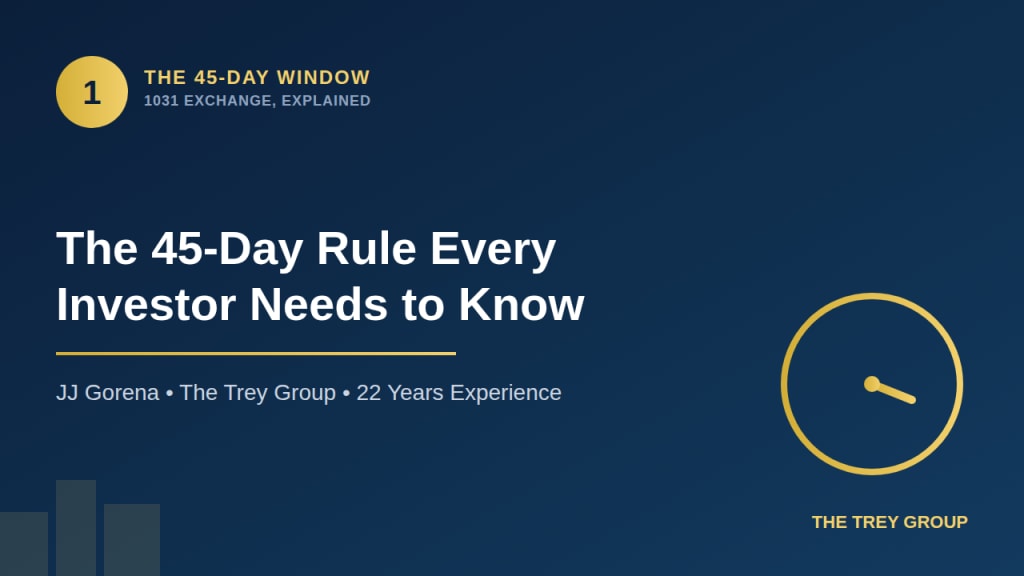
Section 1031 of the Internal Revenue Code lets an investor sell property held for investment and reinvest the proceeds into a new property while deferring the capital gains tax that would normally be due at closing. Two deadlines govern the process. You have 45 days from the date your property closes to formally identify potential replacement properties, and 180 days total to complete the purchase. Missing either deadline ends the exchange, and the full tax bill comes due.
JJ Gorena of The Trey Group has guided investors through this process for 22 years, closing more than 700 transactions across residential and commercial real estate. He has represented both buyers and sellers in Olmos Park specifically, with experience in both residential property and commercial flex space, the kind of adaptable, mixed use property that has become an increasingly common 1031 replacement option.
Why Olmos Park Is a Different Kind of Market
Olmos Park is small by design. Its inventory is limited, its property values are consistently strong, and turnover is slower than in larger San Antonio neighborhoods. That combination shapes what a 1031 exchange usually looks like here. A single sale often generates enough in proceeds that the investor is realistically choosing between one larger replacement property and splitting the amount across two or three smaller ones, rather than a simple one to one swap.
Gorena walks through this exact decision in Episode 1 of his 1031 exchange series, using a real example built around roughly one million dollars in proceeds. An investor in that position could identify three properties near that value and select the strongest one after underwriting each, split the amount into one larger property and two smaller ones as backup options, or divide it evenly into three separate properties. That same logic applies to an Olmos Park seller working with a comparable amount.
The Mistake That Causes the Most Problems
The biggest risk to an Olmos Park investor's exchange usually has nothing to do with the identification window itself. It comes down to timing. According to Gorena, too many investors wait until they are ten days from closing to reach out, at which point an exchange can sometimes still be completed but becomes unnecessarily stressful for everyone involved, including the qualified intermediary and both sides' agents.
The right sequence is to meet with a 1031 exchange expert first, complete the required paperwork and set up the exchange account, and only then list the property. Gorena regularly works alongside Carl Pikus of IPX1031, a qualified intermediary serving the San Antonio and Austin markets, so that the real estate side and the compliance side of the exchange move together instead of being handled separately and too late.
What Qualifies as a Replacement Property
Both the property being sold and the property being purchased need to be held for investment, not personal use. A primary residence does not qualify. The replacement property also does not need to match the type of the one sold, which matters in Olmos Park given the mix of residential rental and commercial flex space in the area. A residential rental can become commercial flex space, and the reverse is true as well, as long as both sides of the exchange are investment property.
Why Regional Reach Matters for an Olmos Park Exchange
Because a 1031 exchange allows an investor to identify replacement properties across multiple cities, an Olmos Park seller is not limited to what is available inside the neighborhood itself, which is a meaningful advantage given how little inventory turns over there in any given year. Gorena's team covers the full state of Texas, giving Olmos Park sellers real options in neighboring Alamo Heights and Terrell Hills, as well as further out toward Boerne and New Braunfels, all within the same 45-day window.
Credentials Worth Knowing
Beyond his transaction history, Gorena has been recognized alongside partner Bobby Cortez as part of a Top 25 Real Estate Team in San Antonio by the San Antonio Business Journal. He is also an Emmy-nominated and Telly Award-winning host on The American Dream TV, and has appeared as a featured host on THE LOCAL, a show that has aired on Travel Channel. None of that changes the mechanics of a 1031 exchange, but it reflects the kind of visibility and track record worth knowing about when choosing who to trust with a transaction on a strict legal deadline.
Getting Started
If you own property in Olmos Park and expect to sell within the next year, the right time to start planning a 1031 exchange is now, not after you have already accepted an offer. Watch Episode 1 of "1031 Exchange, Explained" for a full walkthrough of the identification period, and reach out directly to talk through your specific property and timeline.
Watch Episode 1 of "1031 Exchange, Explained": https://youtu.be/Kmbth-XiI50
Schedule a consultation with JJ Gorena: https://calendly.com/treygroupcommercial/15min
JJ Gorena, The Trey Group Phone: 210-367-6024 Email: homes@thetreygroup.com